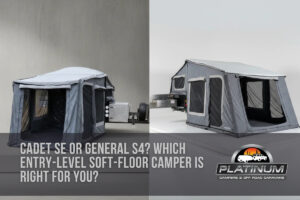

Cadet SE or General S4? Which Entry-Level Soft-Floor Camper Is Right for You?
Quick answer: Choose the Cadet SE if you want the lightest, most affordable way into off-road camping and you don’t mind climbing a ladder to bed. Step up to the General S4 if you want easy step-through bed access, room for more adults, and extra storage and power, and your tow vehicle can handle 2,000kg. Both are genuine off-road soft-floor campers built on the same chassis, suspension and kitchen, so this really comes down to access, space and towing weight. Here is the full breakdown so you can match the right camper to your family and your 4WD. Key Takeaways Cadet SE vs General S4: Side-by-Side Feature Cadet SE General S4 Price (from) $15,899* $17,899* Finance (from) $77/week* $86/week* Sleeps (guide) 2 adults + 4 children 4 adults + 4 children Bed access Ladder Step-through internal stairs Tare weight 1,000kg 1,100kg ATM 1,700kg 2,000kg Payload (approx.) 700kg 900kg Main tent size 5,200 x 2,100mm 5,000 x 2,800mm Power outlets 3 x 12V + 1 USB 5 x 12V + 2 USB Entertainment Bluetooth stereo Built-in entertainment system Pantry drawer No Yes Warranty 5 years structural 5 years structural *Pricing is ex Brisbane collection and excludes dealer delivery and registration. Request a quote to confirm all costs. What Both Campers Share Before the differences, it helps to know how much these two have in common, because it is a lot. Both are Australian-designed soft-floor campers engineered for full off-road use, so neither is a compromise on toughness. Each rides on dual-shock independent suspension with trailing arms and heavy-duty coil springs, a fully galvanised hammertone chassis, and 15-inch 6-stud off-road XD rims. Both use an ARK 2,000kg 50mm ball hitch with a 250kg jockey wheel, giving genuine ground clearance and departure angles for rough tracks. Inside, both deliver the same core comforts: a full stainless-steel kitchenette with a sink, servery, two drawers and a four-burner gas stove, a queen high-density memory-foam mattress, an internal privacy screen, a large fridge slide, an onboard battery with a power management system, a mesh stone guard, a plumbed drawbar tap, and a 1kg fire extinguisher. Setup takes about 7 minutes and packdown around 8 minutes on either model. In short, you are choosing between two versions of the same well-built platform, not two different classes of camper. For background on the format itself, see Platinum’s guide to the benefits of a soft-floor camper trailer. The Defining Difference: Ladder vs Step-Through The single biggest reason to choose one over the other is how you get into bed. The Cadet SE uses a ladder to reach its queen bed. It is simple, it works, and for fit adults and active kids it is a non-issue. If you are young, agile, and travelling light, the ladder saves weight and money. The General S4 uses internal step-through stairs. You walk up into the sleeping area through the camper rather than climbing an external ladder, and you can close the section off for privacy at night. This matters more than it sounds. For older campers, anyone with a sore knee or back, parents doing midnight trips for small children, or anyone who simply values comfort, step-through access is a meaningful upgrade. If bed access is the only thing you are weighing, the question is straightforward: prioritise budget and weight, pick the Cadet; prioritise easy access and comfort, pick the General. Space and Sleeping Capacity Both campers boast a huge open tent, but they are shaped differently. The Cadet’s main tent measures 5,200 x 2,100mm, while the General’s is 5,000 x 2,800mm. The General trades a little length for a lot more width, giving it roughly 14 square metres of tent floor versus the Cadet’s 10.9, about 28% more living space. That extra width is why the sleeping guide differs. The Cadet SE is rated for 2 adults and 4 children, ideal for a couple with kids. The General S4 steps up to 4 adults and 4 children, making it the better pick for larger families, two couples travelling together, or anyone who wants room to spread out on longer trips. Both models offer an optional kids’ room to extend capacity further, so neither locks you in. But if you already know you need to sleep more adults, the General is built for it. Storage and Power Storage is generous on both, thanks to compartmentalised boxes, three full-length 1,700mm pole tubes, and a large fridge slide. The Cadet SE was upgraded from the older Cadet S2 with enclosed sides and seven dedicated storage compartments, so it punches above its price on organisation. The General S4 goes further, marketed as having “more storage than Storage King,” and adds a pantry drawer above the kitchen for cooking supplies and cutlery. Its higher payload also means you can legally carry more gear, which matters on extended trips. Power tells a similar story. The Cadet SE runs 3 x 12V sockets and 1 USB, while the General S4 doubles up with 5 x 12V sockets, 2 USB ports, and a built-in entertainment system. Families running fridges, lights, fans and devices will appreciate the General’s extra capacity. Weight and Towing: This May Decide It Weight is where your tow vehicle gets a vote. Understanding two numbers makes this easy. Tare is the empty weight of the camper. ATM (Aggregate Trailer Mass) is the most it can legally weigh fully loaded. The gap between them is your usable payload. The Cadet SE has a tare of 1,000kg and an ATM of 1,700kg, leaving around 700kg of payload. The General S4 has a tare of 1,100kg and an ATM of 2,000kg, for roughly 900kg of payload. That 300kg ATM difference is significant. A 1,700kg Cadet sits comfortably within the braked towing limit of many mid-size SUVs, giving you towing headroom. A 2,000kg General sits right at the limit of a 2,000kg-rated vehicle, so it leans toward a larger SUV or 4WD with capacity to spare. Both campers exceed 750kg, so they must be towed with a braked setup.